
Same Team, Different Rooms
Parents and schools don't need to fight about screens. They need a shared playbook.

In Mesick, Michigan, Chromebooks are piled on bookshelves and stacked in dish racks. An elementary school banned them overnight — literally, after one conversation between a superintendent and a principal — because only 18% of their third graders were reading at grade level. In suburban Philadelphia, twenty families in a single grade at Cynwyd Elementary are planning to opt out of Chromebooks next year. In Los Angeles, a parent coalition called Schools Beyond Screens is pushing to eliminate one-to-one devices for kids through second grade. Parents are organizing through group chats, sharing opt-out toolkits, and swapping strategies for getting their kids back to pen and paper. NBC News called it a growing network of families teaching one another how to get their children off school-issued devices.
I understand every one of these parents. I have two young kids of my own, and I think about what their school experience will look like more than I probably should. I don’t want my children parked in front of a screen for an hour while a teacher manages a different group. I don’t want gamified apps replacing the actual teaching. I don’t want YouTube filling time that should be spent reading, building, or talking to each other.
The frustration driving the opt-out movement is legitimate. Schools bought millions of devices during the pandemic — nearly 9 in 10 public schools now provide a device for every middle and high school student — and in too many classrooms, nobody stopped to ask what those devices were actually for. Teachers were handed Chromebooks and wished good luck. Professional development, when it existed, was a two-hour August session that nobody remembered by September. The technology arrived without intention, without training, and without a clear pedagogical purpose. I’ve said it before and I’ll say it again: that was abandonment dressed up as innovation.
So when parents walk into a classroom and see a first grader on an iPad for an hour, or a sixth grader gaming on a Chromebook during indoor recess, or a kindergartner wearing headphones while an app teaches a lesson a teacher should be delivering — the response isn’t irrational. It’s earned. A 2025 EdWeek Research Center survey found that 56% of educators themselves said off-task behavior on devices is a major source of distraction. The teachers know. The parents know. Everyone knows.
What I’m asking is that we don’t let that earned frustration lead us somewhere that makes things worse.
Sixteen states have introduced legislation in 2026 to reevaluate screen time or vet educational technology. Some of those bills propose capping elementary screen time. Others would create new vetting processes for software. A few would ban school-issued devices entirely in early grades. And the Distraction Free Schools Policy Project — the same group behind the phone-free school movement — is now pushing legislation to eliminate all screen technology in elementary schools.
The energy is moving from “phones out of schools” — a position I largely agree with — toward “all screens out of schools,” which is a fundamentally different proposition. Personal phones are distractions by design. They weren’t built for learning. School-issued devices, deployed with intention and purpose, are not the same thing. Conflating them is a mistake that will cost kids.
There are students who rely on assistive technology built into those devices. There are families who can’t afford a computer at home, and the school-issued device is their child’s only access to digital tools. There are teachers running creative, purposeful lessons that genuinely work better with technology — not as a replacement for teaching, but as an extension of it. When we throw out all of it because some of it was misused, we’re not protecting kids. We’re punishing them for a failure that belongs to the adults in the room.
Here’s what I think we’re missing in this debate: parents and schools are fighting like they’re on opposite sides when they’re actually trying to solve the same problem. Parents want their kids engaged, learning, and not glued to a screen that’s doing more harm than good. Teachers want the same thing. Principals want the same thing. The disconnect isn’t about values. It’s about the absence of a shared framework — a common set of agreements about when screens make sense, when they don’t, and what we’re all doing about it. That’s the work. Not banning. Not defending. Building the thing that should have existed before a single device was purchased.
What does that look like in practice? It starts with something deceptively simple: schools need to be able to answer the question why is this device in my child’s hands right now? Not vaguely. Not with a reference to the purchase order or the district technology plan. A specific, pedagogical reason. If a teacher can’t articulate what a screen is doing that couldn’t be done another way — or why the screen is the better choice in that moment — the screen shouldn’t be out.
And parents need to be willing to hear that answer when it exists. Not every screen moment is a failure. Not every app is a babysitter. When a teacher has a clear purpose and the training to execute it, the device earns its place. So what does a real partnership look like? Here’s where I think both sides have work to do.
What schools owe families. Transparency. Not just about which devices and apps are in use, but about why. A school that can’t explain its technology philosophy to parents in plain language doesn’t have one. That means publishing a clear framework for when and how devices are used at each grade level. It means dedicating real professional learning time — not one afternoon in August — to helping teachers use technology with intention. It means creating screen-free protected time in the school day where devices stay closed and kids interact with their teacher and each other. And it means being honest when something isn’t working instead of defending a purchase.
What families can do at home. The conversation about screens can’t stop at the school door. If we’re asking teachers to be intentional, we have to be willing to do the same thing at dinner. That means examining our own screen habits — not just our kids’. Research published in 2024 found that one of the strongest predictors of a child’s screen time is a parent’s screen time. We can’t set rules we don’t follow ourselves. It means talking with our kids about what they’re doing on screens and why. It means creating spaces — meals, car rides, weekend mornings — where devices aren’t present and nobody has to fight about it because the expectation is clear.
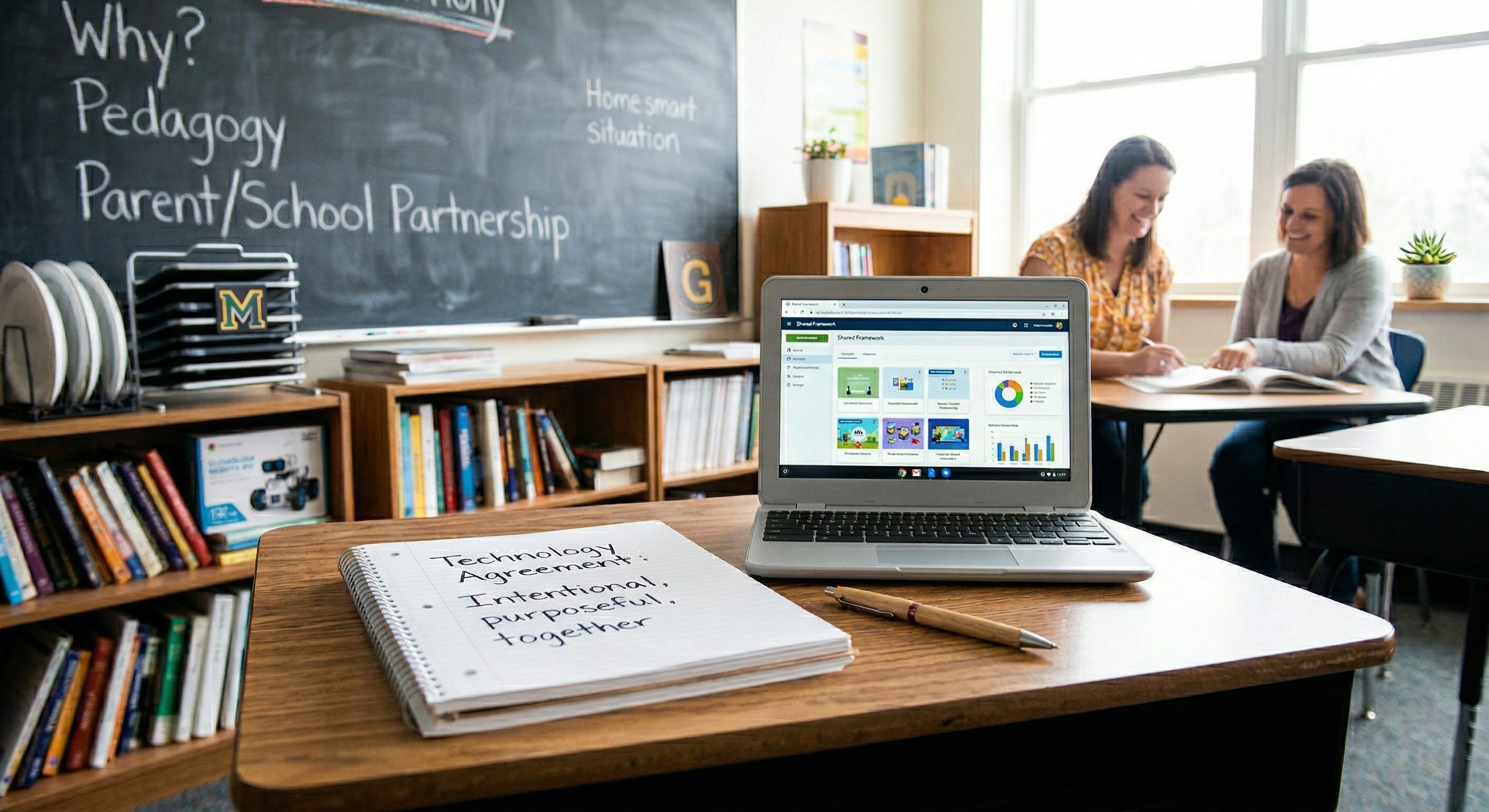
What we build together. This is the part that almost nobody is talking about, and it matters the most. Parents and schools need a shared language around technology use. That could look like a family-school technology agreement that goes both ways — not just an acceptable use policy the family signs, but a mutual commitment. The school commits to purposeful, limited screen time and ongoing teacher preparation. The family commits to reinforcing those norms at home and engaging with the why behind school technology decisions rather than assuming the worst. Both sides commit to revisiting the agreement annually because the landscape changes, kids grow, and what worked in second grade won’t work in sixth.
It could also look like schools inviting parents into the conversation before purchasing new tools — not to give them veto power, but to build understanding and trust. When parents see the plan, not just the purchase order, the adversarial dynamic softens. When families understand that a 20-minute adaptive math session on a tablet was chosen because the data shows it fills a specific gap for their child, the Chromebook stops being a threat and starts being a tool.
I keep coming back to one idea that sits underneath all of this: the problem was never the screen. The problem was that we deployed technology without asking what it was for, without preparing the people using it, and without talking to the families on the other end of the school day about what was happening and why.
The opt-out movement is a signal. It’s parents saying, loudly, that they’ve lost trust. And the only way to rebuild that trust is to stop treating technology decisions as administrative logistics and start treating them as what they are — decisions about how we’re raising and educating children.
I don’t want my kids in a classroom with a screen that has no purpose. But I also don’t want them in a school that removed every piece of technology because it was easier than doing the work of using it well. Those are both failures of the same thing: intention.
Parents and schools are in different rooms right now, shouting about the same problem. It’s time to walk into the same room. Sit down. And build the thing together.