
Integrity: How do we verify and attribute?
Deep-dive #4 in the Forward Lens series.

A teacher I worked with held up two student essays during a planning meeting. Both were clean. Both hit the rubric. “I can’t tell,” she said, “which one of these a student actually wrote — and I can’t prove anything either way.” She wasn’t angry. The tools had outrun her ability to know whose thinking she was reading.
That uncertainty arrived almost overnight. For most of the history of schooling, the line between a student’s work and someone else’s was reasonably easy to see; plagiarism left fingerprints. Generative AI erased the fingerprints. A tool that can produce clean, original-sounding prose on any topic in seconds doesn’t just enable cheating — it dissolves the very thing assessment depends on: the assumption that the work in front of you reflects the mind that turned it in. That assumption is gone, and no detector is bringing it back.
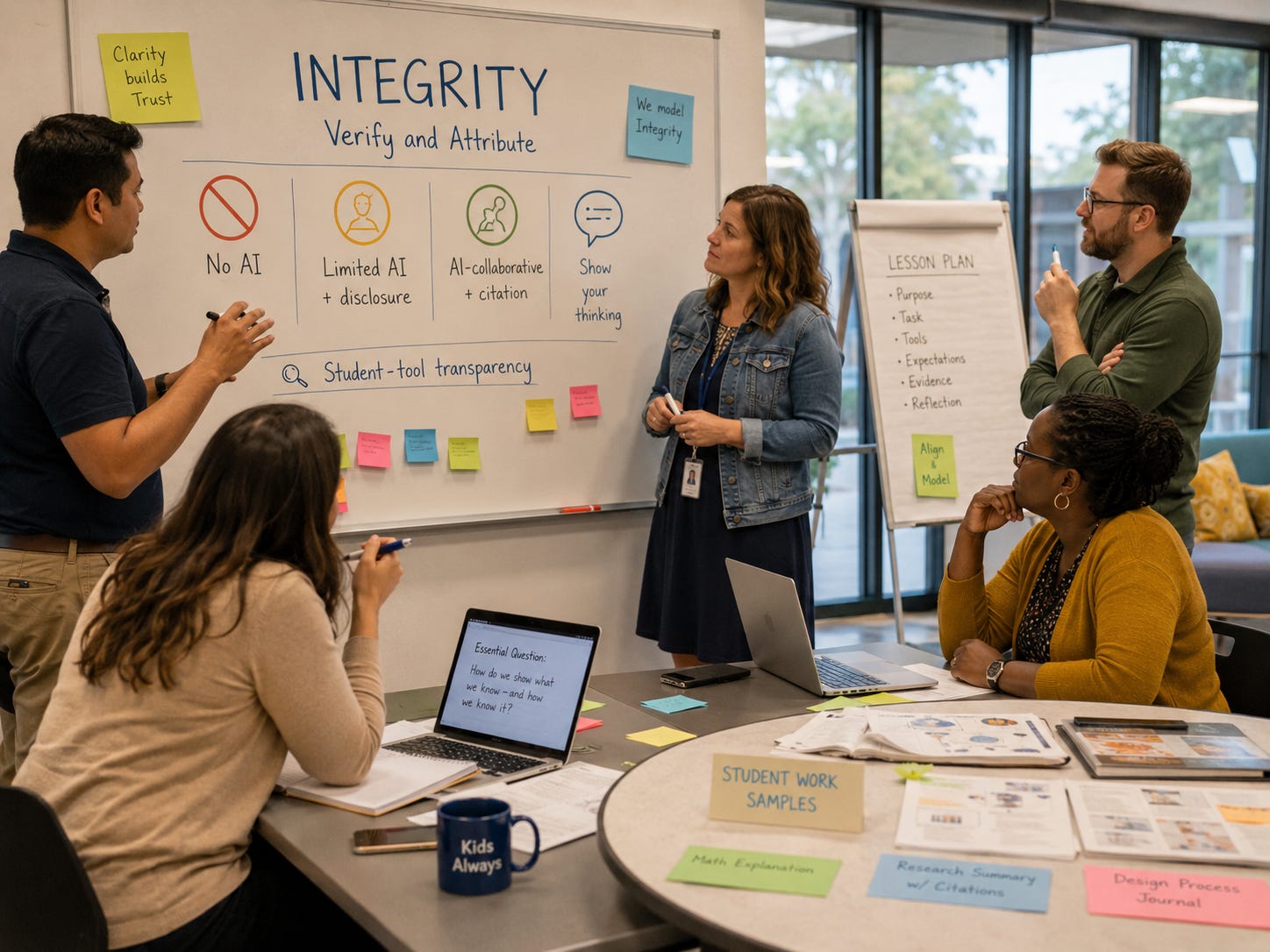
Intention asks why this tool, here, now? Investigation asks what information skills are in play? Implementation asks how are students engaging? The fourth pillar — Integrity — asks the question generative AI made unavoidable: How do we verify and attribute? And by this I am not saying that AI use by students = cheating. That’s actually antithetical to what I have heard and seen from students. Additionally, most students, including any time AI was mentioned at a commencement address this year, were just not into hearing about it. So by no means is this pillar conflating AI with student cheating, but rather helping students navigate the constant stream of SLOP and misinformation.
Integrity is the pillar that did not exist in any previous technology integration framework, because the previous frameworks predated generative AI. SAMR (2010), TPACK (2006), even UDL 2.2 — none of them have language for the central question of every assignment in 2026: whose thinking is this?
That gap is not theoretical. The September 2025 RAND survey of nationally representative samples of teachers, students, and school leaders found that over 80% of students reported their teachers had not explicitly taught them how to use AI for schoolwork — while 54% of students said they were using AI for school anyway. The same survey found that 45% of principals reported having any AI policy at all. The disclosure conversation is happening in the absence of any disclosure language.
This is what happens when the pace of the technology outruns the pace of the pedagogy. Pretending it isn’t happening — or treating AI integrity as only an academic-honor-code issue — leaves teachers without the language they need to teach the actual skill. And the actual skill is not “don’t cheat.” It is knowing what is yours, knowing what is the tool’s, and being able to show the difference.
The most useful research on AI integrity in K-12 is not the research about catching cheaters. It is the research about disclosure-as-pedagogy — teaching students to make their AI use visible, in the same way good academic work has always made source use visible.
The UNESCO AI Competency Framework for Teachers (2024), drafted by Fengchun Miao and Mutlu Cukurova, names fifteen competencies across five dimensions. The framework explicitly positions AI as transforming “the traditional teacher-student relationship into a teacher-AI-student dynamic” — and teaching that dynamic is now part of teachers’ professional competence. The companion AI Competency Framework for Students places “Ethics of AI” as one of its four core dimensions.
The AFT’s Commonsense Guardrails for Using Advanced Technology in Schools, Version 2 (2025) was developed by classroom teachers and built around six core values: maximize safety and privacy, promote human interaction, empower educators, teach digital citizenship and balance, advance democracy, and build ethical oversight. The document is specifically designed to help teachers have the conversation — with students, with parents, with administrators — about what AI use is acceptable in school and how it should be disclosed.
Child Trends’ Framework for Coherent AI Use in K-12 Education (Kelley & Holquist, 2025) is more direct: a pedagogically coherent tool should “provide step-by-step feedback without giving away the final answer” and “encourage students to reflect on their thinking and learning process.” The framework’s premise is that disclosure isn’t just about honesty — it’s about preserving the learning itself. A student who never has to show their own reasoning never builds it.
The emerging best practice across these frameworks is what some researchers are now calling a three-tier disclosure scaffold: assignments are categorized as No AI (the student’s thinking must be unaided), Limited AI with disclosure (specific narrow uses are permitted and must be named), or AI-collaborative with citation (the tool is a working partner and its contributions are explicitly cited). The AI Disclosure (AID) Framework developed by Kari Weaver applies a similar logic at the higher-education level, adapting the Contributor Roles Taxonomy (CRediT) used in academic publishing. The principle is the same: transparency about contributions, baked into the assignment, not bolted on after.
A growing number of districts and states have moved past “ban AI” or “allow AI” into the more useful work of teaching disclosure.
Charlotte-Mecklenburg Schools (NC) released its AI Vision and 2025-26 Generative AI Guidance in spring 2025. In October 2025, the board added a formal AI policy emphasizing training, privacy, and responsible use. The district’s posture is unusual: AI is treated as a supplemental resource, not a substitute, with thirty “AI Champion Schools” piloting specific tools and reporting back.
Massachusetts DESE’s 2025 AI Guidance explicitly cites the AFT Commonsense Guardrails as one of its foundational documents and provides a framework for districts to develop their own disclosure norms.
Georgia DOE’s January 2025 AI Guidance does something most state guidance avoids: it makes a clear distinction between high-stakes and non-high-stakes AI uses, with specific examples of each. It prohibits AI for IEP goals, educator evaluations, and subjective grading. It allows AI for lesson planning, rubric development, and multiple-choice grading. The clarity itself is the contribution.
New Mexico PED’s 2025 AI Guidance uses the M.A.Z.E. framework (Monitor, Assess, Zero-in, Evaluate) and includes age-appropriate AI education strategies for K-5, 6-8, and 9-12.
At the union level, the AFT’s National Academy for AI Instruction — launched in 2025 with founding support from OpenAI — is training 400,000 K-12 teachers over five years on AI use that meets the Commonsense Guardrails standard. Whatever one’s view of the funding source, the scale of the training effort is the largest formal disclosure-norm-building initiative in U.S. education.
The most direct UDL 3.0 mapping for Integrity is the combination of Action & Expression and Engagement — and specifically UDL 3.0’s shift from “expert learners” to learner agency.
Agency is impossible without identity. Knowing what is yours — and what came from somewhere else — is not a compliance question. It is an identity question. UDL 3.0’s emphasis on cultivating learners who are purposeful and reflective, resourceful and authentic, strategic and action-oriented requires that students know which parts of their work are theirs in the first place. Disclosure norms make that identity question visible. They are not about catching cheaters. They are about helping students know themselves as learners in an era when a tool can do the visible work for them.
Three practices that can be added without rewriting a single assignment.
The three-tier disclosure scaffold. Every assignment is labeled as No AI, Limited AI with disclosure, or AI-collaborative with citation. The label appears on the assignment itself. The norms are taught explicitly, not assumed.
The “show your thinking” redesign. Any assignment where the final product could plausibly be AI-generated includes a visible thinking artifact — drafts, voice memos, in-class checkpoints, photo of a whiteboard — that demonstrates the student’s reasoning regardless of what tool was used in the loop.
The teacher-student co-authored use agreement. Each class, at the start of a unit, drafts a short shared agreement about what counts as acceptable AI use for that unit. Drafting it together is the lesson. The agreement itself is the artifact.
The team practice this week
A three-tier disclosure scaffold drafted for your specific department or grade level. A list of assignment types mapped to disclosure tiers. A teacher-facing one-pager and a student-facing one-pager. A check-in date. Ninety minutes. One department-wide AI use agreement your students will see consistently across every classroom for the rest of the year.

What’s next
Next post: the final pillar — Impact — and the question schools have spent four years avoiding. What did the post-pandemic 1:1 program cost students in attention, focus, and well-being? And what is our responsibility, as the adults in the building, to make that cost visible to them — and to ourselves? If Integrity is the pillar that asks whether we can tell the student’s work from the tool’s, Impact is the pillar that asks whether the screen is worth what it took to put it there.